Showing posts with label 2012s. Show all posts

Sunday, 30 December 2012

Let's Double Down On A Superstorm Of Malarkey: Picking 2012's Word Of The Year

Selfie, one of the candidates for 2012's Word of the Year, means a self-portrait photograph, usually posted to a social networking site.

textsfromhillaryclinton.tumblr.com/Original image by Diana Walker for Time Selfie, one of the candidates for 2012's Word of the Year, means a self-portrait photograph, usually posted to a social networking site. Selfie, one of the candidates for 2012's Word of the Year, means a self-portrait photograph, usually posted to a social networking site.
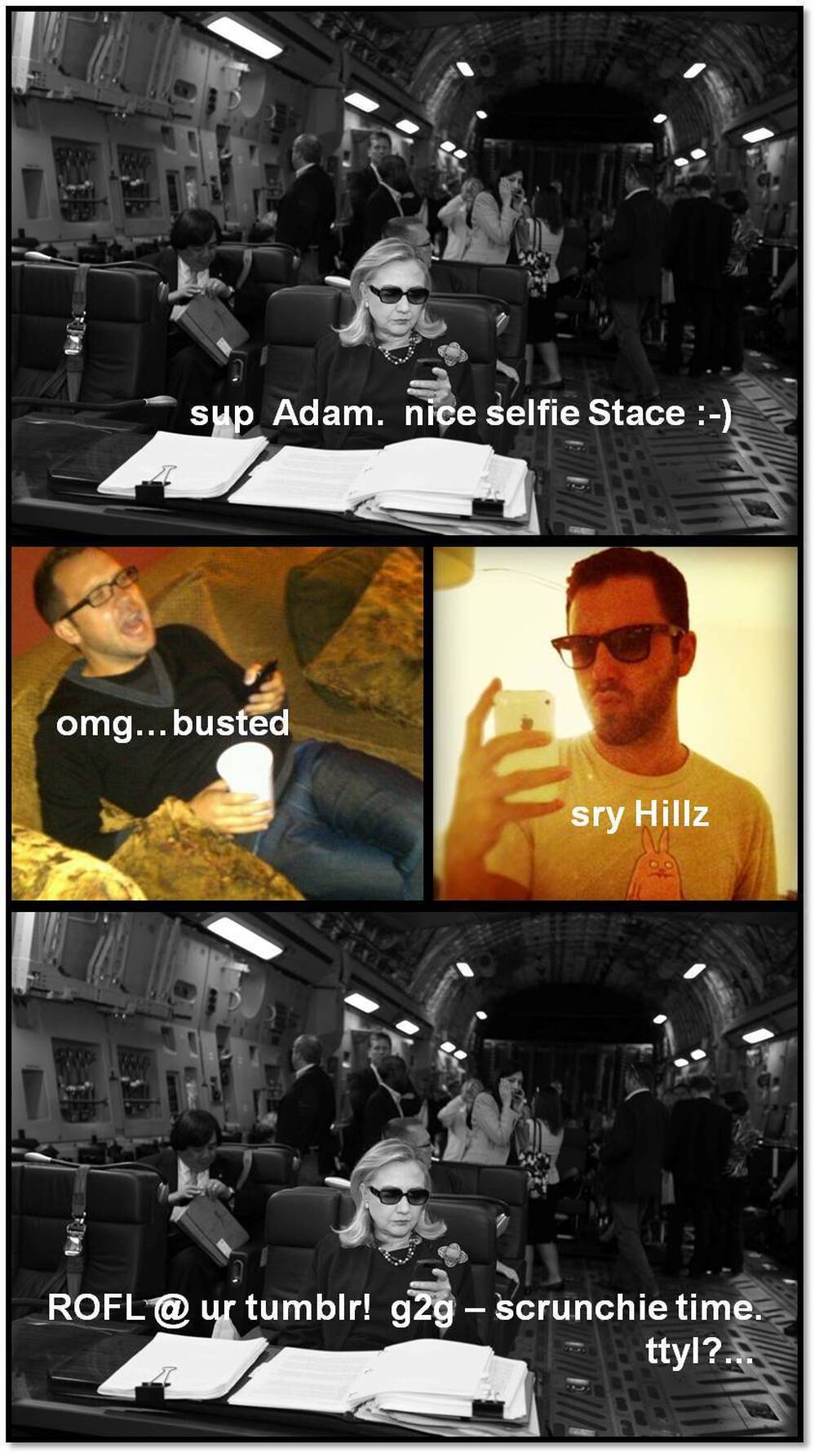
textsfromhillaryclinton.tumblr.com/Original image by Diana Walker for Time

There is a major decision coming up that will truly define the year 2012. Yes, it's almost time for the American Dialect Society to once again vote on the Word of the Year. Will it be selfie? Hate-watching? Superstorm? Double down? Fiscal cliff? Or (shudder) YOLO?

Ben Zimmer is a language columnist for the Boston Globe, and the chair of the ADS's New Words Committee. He tells NPR's Renee Montagne that the Word of the Year can be either a word or a phrase, as long as it's achieved new prominence in 2012. "You might have heard about YOLO, the acronym for 'you only live once.' YOLO caught on this year as a bit of youth slang that young people are already a little sick of."

A selfie is a self-portrait photograph, usually posted to a social networking site — and used most memorably by Secretary of State Hillary Clinton (or, let's be honest, one of her aides) in a humorous message to the Texts from Hillary Tumblr account. "Another word that I was introduced to this year which I quite like, hate-watching, which describes the masochistic act of continuing to watch a TV show even if you hate it."

And of course there were the old-fashioned words that resurfaced this year, like malarkey, popularized by Vice President Joe Biden in a debate with Paul Ryan. "That's a great Irish-American word that's been around for about a century ... it's such a great evocative word and it grabbed people's interest," Zimmer says. "It turns out it was Irish-American newspaper writers who popularized it in the early 20th century."

Some words captured public attention for sadder reasons, like superstorm, coined to describe Hurricane Sandy. "Someone from the National Weather Service actually suggested Frankenstorm, because it was a hybrid of different weather systems, like Frankenstein's monster, and it was also going to hit around Halloween," Zimmer says. But many news organizations considered Frankenstorm too light-hearted in the wake of the disaster, so the consensus settled on superstorm.

Last year, the concepts of the one percent and the 99 percent were on everyone's mind — giving rise, in a way, to this year's prominent percentage: 47. "If you think about the impact of last year's Occupy movement, the idea of breaking the population into percentages based on some sort of economic factor was powerful," Zimmer says. When Mitt Romney was caught on tape decrying 47 percent of the American electorate as "dependent on government," he adds, that became "a real touchstone of the election."

Gambling metaphors were also big this year, particularly doubling down, a high-risk, high-reward play in blackjack, which can be used in either positive or negative ways — such as when former President Bill Clinton described Romney as someone who will "double down on trickle-down" economics.

There's no clear front-runner among all these choices, Zimmer says. "Last year, I think it was pretty obvious going in that Occupy was the prohibitive favorite. Certainly, the term fiscal cliff has been used a lot in the last few months, and that could end up being the winner, in the same way that, for instance, bailout was the winner for the American Dialect Society four years ago. It could be coming from pop culture, or the tech world — there's a lot of possible choices this year."

View the original article here

Thursday, 20 December 2012

In 2012's Best Mysteries, Mean Girls Rule

Nishant Choksi Best Mysteries of 2012

Mean girls and their ingenious female creators top my mysteries and thrillers list this year. Maybe it takes the special discernment of a female writer (who's presumably suffered through the "Queen Bee and Wannabee" cliques of middle school) to really capture the cruel mental machinations that can hide behind a pair of shining eyes and a lip-glossed smile.

It's ironic to recall that American pulp detectives used to dismissively refer to women as "frails." Those tough guys wouldn't dare use that term about the women in — or authors of — some of these books. They'd be garroted with their very own Y chromosomes faster than you can say "Nancy Drew."

Gone Girl

It's the highest compliment I can pay to Gillian Flynn to say that she must have mind-melded with that Medusa of Snaking Storylines Patricia Highsmith to write Gone Girl. It is, simply put, the thriller of the year. Never once can readers rest easy while making their way through Flynn's maze of double crossings, multiple testimonies, masquerades and red herrings. By its final chapter, this macabre tale effectively disables readers' moral GPS systems: Sin turns into virtue, and the most heinous acts of destruction become imbued with the bright colors of a Candy Land game board.

Gone Girl is about the total meltdown of a marriage. Nick and Amy Dunne were once a glittering couple who lived in Brooklyn Heights and reveled in their good looks, fun writing jobs and pots of money. But the economic downturn and the evaporation of print journalism knocked their privileged planet off its axis. When the novel opens, the couple have moved back to Nick's Missouri hometown to reduce expenses. It's the morning of their fifth wedding anniversary, but we readers sense that something is off by how Nick describes his breakfast encounter with Amy:

"When she spied me lurking there in grubby boxers, my hair in full Heat Miser spike, she leaned against the kitchen counter and said, 'Well, hello, handsome.'

"Bile and dread inched up in my throat. I thought to myself. Okay, go."

Before the day is out, Amy has disappeared and Nick is the No. 1 suspect. That's all the plot of this malevolent tour de force that I'm going to reveal.

The Stonecutter

Yet another Swedish mystery writer made a big splash this year (there must be some magical mystery ingredient in all those lingonberries Swedes eat). Camilla Lackberg's The Stonecutter is an ingenious tale of rotting families and the long reach of evil. There are two primary and at least five subsidiary storylines in Lackberg's diabolical novel; all of them slither seamlessly in and around each other in one big snake pit of warped desire.

The most disturbing storyline begins in 1923 and concerns the young, beautiful and bad-to-the-bone Agnes Stjernkvist. Agnes' prosperous father owns the local granite quarry and is blind to his princess's budding sociopathic tendencies. We readers, however, are not spared: "Agnes never would have dared to say it out loud, but sometimes she thought it was lucky that her mother had died when she was born. That way, she'd had her father all to herself." Agnes dupes a muscular young stonecutter into marriage — a marriage that will culminate, over a century later, in the horror of a drowned child and a police force frantically racing to uncover a domestic monster. Lackberg has been hailed as "the Swedish Agatha Christie." Mystery purists will snort, but Lackberg may possibly have the last laugh — she's that good.

Broken Harbor

Tana French's Dublin Murder Squad series is an intricate delight: Beginning with her 2007 debut, In the Woods, which was showered with that year's major mystery awards, French's stories have been serially scrutinizing members of an elite police unit known as the Dublin Murder Squad. Though the novels work beautifully as standalones, French's mysteries gain psychological gravitas when read sequentially, since we see various detectives from a variety of perspectives. As the series proceeds, we readers come to realize just how wobbly our knowledge of anybody's "true" nature is. That epiphany is especially jarring in Broken Harbor, French's fourth novel in the series; the police detectives and chief suspects alike remain ciphers until almost the last page.

In the novel, when members of a young family are murdered in their home, suspicion falls on the mother and father. In addition to everything else this psychologically rich story has going for it, the setting is a doozy. The family home is in a luxury housing development called Ocean View. Foreclosure signs dot the landscape and, in the murder house, telltale signs of madness abound: holes in the walls and ceilings, buckled flooring, baby monitors planted around the rooms. Detectives Mick "Scorcher" Kennedy and his rookie partner, Richie Curran, must read the clues scattered throughout this nightmare of a manse — clues that reveal as much about the psychological fallout of Ireland's economic collapse as they do about the killer's identity.

The Beautiful Mystery

Given that it's set inside the walls of an isolated monastery deep in the northern forests of Quebec province, there's not a woman of mystery to be found in Louise Penny's harrowing The Beautiful Mystery — except, of course, for the accomplished author herself. Penny has been writing the Chief Inspector Gamache mysteries for a while now (this is her eighth), and the series is distinguished by the emotional acuity with which she depicts the prickly relationship between Gamache and his sidekick at the Surete du Quebec, Inspector Jean-Guy Beauvoir.

In this atmospheric tale, Gamache and Beauvoir are summoned to the 200-year-old (fictional) monastery of Saint-Gilbert-Entre-les-Loups to investigate the murder of Brother Mathieu, the choirmaster who was responsible for marketing the monks' surprise hit recording of Gregorian chants. The detectives find a scrap of vellum in Brother Mathieu's cold fist with some ancient musical notations known as "neumes" scrawled on it. Could this scrap come from a manuscript that would provide the long-sought solution to the "beautiful mystery" of the origins of Gregorian chant? Gamache and Beauvoir settle into Spartan cells at the abbey to crack these and other even more vexing mysteries closer to home.

Gaudy Night

The Downton Abbey craze may have had something to do with HarperCollins' decision to help launch its new paperback mystery imprint, Bourbon Street Books, with reprints of four classic Dorothy Sayers novels featuring Lord Peter Wimsey and his sleuthing inamorata, Harriet Vane. The four titles are, in order of publication, Strong Poison, Have His Carcase, Gaudy Night and Busman's Honeymoon. Though the Wimsey-Vane mysteries are set in the Great Britain of the 1930s, their arch dialogue and refined atmosphere link them to the older world of the Crawleys and their servants.

All of Sayers' Golden Age tales featuring Wimsey and Vane are standouts, marked as they are by a distinctive atmosphere of restrained erotic yearning. But the masterpiece of this quartet — and of Sayers' career — is Gaudy Night. That story focuses primarily on Harriet (a fallen woman, gasp!), who returns to her class reunion at Oxford's "Shrewsbury College," which is based on Sayers' own alma mater of Somerville College. Almost as soon as she steps onto the Gothic grounds of the campus, Harriet becomes enmeshed in a case involving vicious pranks aimed at the faculty and students of the all-women's institution. I once met a woman who had read Gaudy Night upward of 50 times; I well understand that obsession. Beyond its haunting atmosphere and utopian fantasies about the academic life, Gaudy Night delves deep into the mystery of women's place in society, a puzzle that bedevils many readers to this day.


View the original article here