Showing posts with label Impossible. Show all posts

Friday, 21 December 2012

Reliving An 'Impossible' Catastrophe

The Impossible is based on the true story of a family's brush with disaster while vacationing in the Pacific.

The Impossible is based on the true story of a family's brush with disaster while vacationing in the Pacific.

Jose Haro/Summit Entertainment

The Impossible

Director: Juan Antonio BayonaGenre: DramaRunning time: 114 minutes

Rated PG-13 for intense realistic disaster sequences, including disturbing injury images and brief nudity

With: Ewan McGregor, Naomi Watts

Starring flying debris and surging walls of water, The Impossible takes the template of the old-timey disaster movie, strips it to the bone and pumps what's left up to 11.

Decades ago, perched in front of Earthquake and The Poseidon Adventure and The Towering Inferno, audiences were rewarded with thrills that depended on fleshed-out characters (Steve McQueen as a fire chief!) and multiple interconnected storylines. How pampered we were.

Because this based-on-true-life tale of a Spanish family trapped in Thailand by the 2004 tsunami is much worse than a disaster: It's an ordeal. As punishing to watch as it must have been to film — especially for Naomi Watts, who absorbs most of the abuse — this sledgehammer of a picture never lets up. From start to finish, Watts' pale, slender body is pummeled, gored, pierced and raked over what looks like acres of saw grass and jagged detritus. Like James Franco in 127 Hours (an ordeal movie if ever there was one), Watts isn't so much battling the elements as battling the frailties of her own flesh.

Cycling through the late-night talk shows, Watts and her co-star, Ewan McGregor, have been extolling a slavish devotion to accuracy on the part of the film's Spanish director, Juan Antonio Bayona, and his screenwriter, Sergio G. Sanchez. It bears mentioning, however, that this precision has a very narrow focus, encouraging us to care only about a single (white, wealthy) family among the hundreds of thousands of (mostly poor, mostly brown) locals killed and maimed. For all the energy and ingenuity lavished on the project — the first to revolve around this century's greatest natural tragedy — you'd think there would have been room to explore the wider suffering.

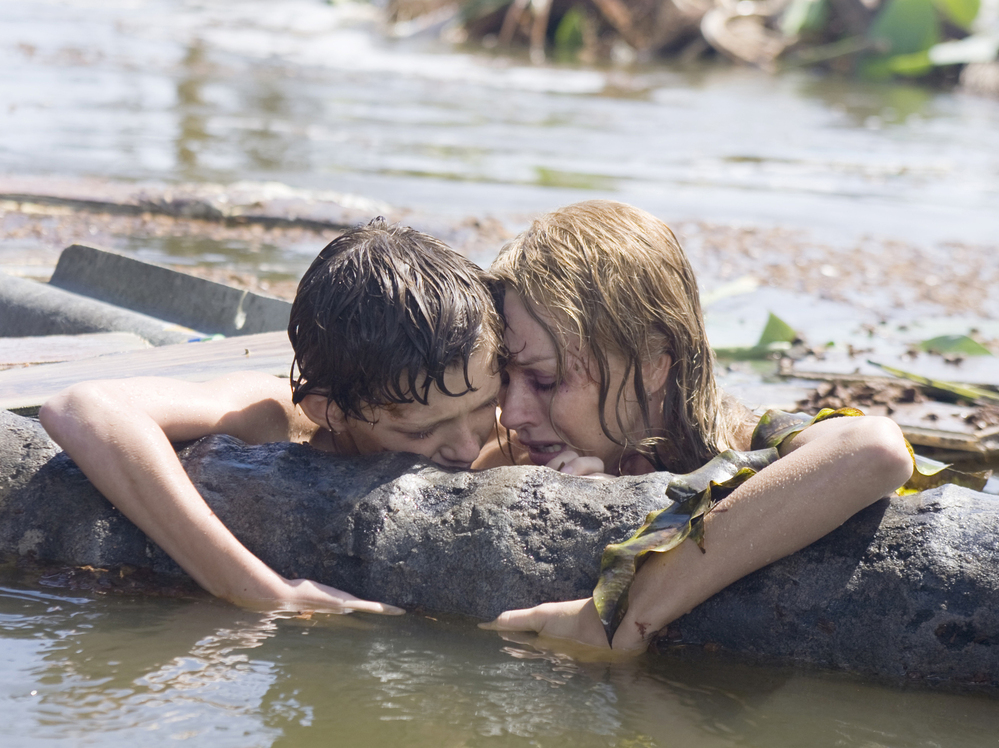
Maria (Naomi Watts) and Lucas (Tom Holland) are ripped from their family by a tsunami.

Jose Haro/Summit Entertainment Maria (Naomi Watts) and Lucas (Tom Holland) are ripped from their family by a tsunami. Maria (Naomi Watts) and Lucas (Tom Holland) are ripped from their family by a tsunami.
Jose Haro/Summit Entertainment

This microscopic approach may be economical, but it casts a pall of selfishness over events that might have read differently had the filmmakers exhibited a more universal compassion. (Those early disaster movies knew it was more humane, not just smarter filmmaking, to offer us a variety of victims.) So when businessman Henry Bennett (McGregor) dumps his two youngest sons with strangers while he hunts for his wife, Maria (Watts), and their oldest son, Lucas (a remarkable Tom Holland), he seems less the worried patriarch than a man accustomed to offloading inconveniences.

As it turns out, Henry is pretty much peripheral to the action anyway. From the moment the family, hours after arriving at a luxury beach resort, is separated by the mountainous tidal wave, he barely registers. Stuck on the fringes of the movie and squinting through a bad case of pinkeye, Henry and his quest are completely obliterated by the mother-son drama unfolding at its center.

And as Maria and Lucas make their slow, bloody way across a devastated landscape, her wide-open wounds are captured with almost sickening authenticity. Audience members have reportedly fainted during screenings, and it's not hard to see why; this isn't a film you want to experience after a heavy lunch.

Visually stunning but manipulative in the extreme — try not to roll your eyes as the various family members miss one another by inches — The Impossible nevertheless contains two of the year's best performances. Though presented as nothing more than a survival machine, Watts snags our sympathy through subtle shifts in expression and tone.

And young Holland (just 13 when he joined the production in 2009) is a marvel: When Lucas, after losing his mother in the chaos of a crowded hospital, finds her being prepped for emergency surgery, his angry relief is the film's most touching moment.

Unfortunately it's followed by one of the funniest. "Think of something nice," advises a nurse as she places an anesthesia mask over Maria's face. Like maybe a beach vacation?


View the original article here

Thursday, 20 December 2012

Naomi Watts, Mulling 'The Impossible'

Maria (Naomi Watts) and her family, including her son Lucas (Tom Holland), fight to survive when they are caught in the 2004 Indian Ocean tsunami.

Maria (Naomi Watts) and her family, including her son Lucas (Tom Holland), fight to survive when they are caught in the 2004 Indian Ocean tsunami.

Jose Haro/Summit Entertainment

The Impossible, a feature film opening Dec. 21, is about a family swept away by the 2004 tsunami in the Indian Ocean. It's based on the true story of a Spanish family.

In the movie, they're British — a couple and their three young sons, on vacation in Thailand. It looks like paradise. Then, the earth trembles, and the ocean roars in, bringing with it catastrophe and heartbreak.

The mother is played by Naomi Watts, who spoke with NPR's Melissa Block about the film and its retelling of a grimly familiar story.

On filming the tsunami sequence

"We spent four weeks in that tank, which became the wave and the current, and it was not only terrifying, but unbelievably exhausting. You know, every single day in there. Everyone knows that working with water is — is a very difficult thing. Well, it certainly lived up to its reputation, and then some."

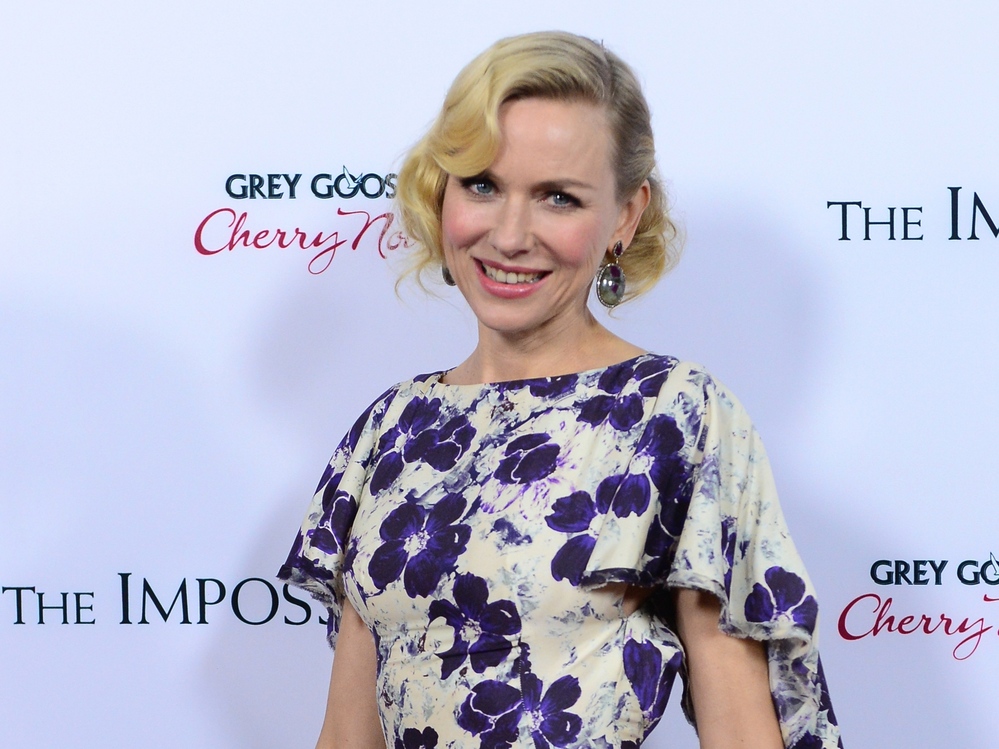
Naomi Watts has won acclaim for her dramatic roles in films such as Mulholland Dr. and 21 Grams. She has been nominated for a Golden Globe for her performance in The Impossible.

Frederic J. Brown/AFP/Getty Images Naomi Watts has won acclaim for her dramatic roles in films such as Mulholland Dr. and 21 Grams. She has been nominated for a Golden Globe for her performance in The Impossible. Naomi Watts has won acclaim for her dramatic roles in films such as Mulholland Dr. and 21 Grams. She has been nominated for a Golden Globe for her performance in The Impossible.

Frederic J. Brown/AFP/Getty Images

On her own fear of water

"When I was about 14, my family emigrated from England to Australia, and we decided to stop in Bali on the way through. And having grown up in England, we were not great swimmers and knew nothing about riptides. Anyway, we got caught in a riptide, and I didn't know what to do other than swim against it, and got to the point of exhaustion, and then just about gave up. But then my mother, somehow, miraculously found sand beneath her feet and just managed to pull me in. And so as a result of that experience, I've always been afraid of the waves and strong currents, so it's quite interesting that I ended up doing this."

On what appealed about the 'Impossible' script

"It came to me through my agent, and he said, 'There's a movie about the tsunami.' And right away I thought, 'Oh, gosh, that doesn't sound right.' You know, is it going to be a disaster movie and become something, you know, spectacular and cool? You know, that would be so wrong, given the amount of lives lost, and this is obviously a very delicate thing that affected so many people.

"Anyway, then they told me the filmmaker, and I — I loved his previous film, The Orphanage, and knew he was a proper filmmaker. So I read the script, it was sent to me, and right away from the first few pages, I knew I had to do it. I just loved the relationships, particularly between mother and son, and how that transformed and, actually, reversed roles in terms of ... him feeling responsible for me, which is something you never want for your child."

On the badly injured tsunami survivor her character was based on

"Maria was always the fighter and always full of courage. When she spoke to me — and we spoke at great length before the movie, during the movie — there was an open dialogue. And she spoke in very articulate ways about how she felt connected to her center more than ever before, and decision-making became really quick and easy. And you couldn't think about the future, you just had to know what to do in that exact moment.

"I had to get into her mindset to play that role and know what it was that she was feeling. Every beat, every moment. And she was incredibly helpful. I mean, every time you play a live character, a real-life character, you — it comes with a certain kind of pressure. And in this case it was the pressure of getting it right and [being] as exact or accurate as possible. Because, given the level of suffering that she went through — and then on top of that the responsibility of telling the story right for all those who lost loved ones or those who lost their lives — that's a big responsibility."

On the film's focus on European rather than Asian victims

"A huge portion of those people that died were tourists. But yes, a lot of them were Thai as well. The thing is, this is not — we couldn't possibly fit all these characters in, and it was really about the family and their experience of it. ... All those years back, when I was watching the news play out, as pulled in as I was, and affected by it, I don't think I understood it. And I think making the film helped me understand it on a much broader scale, including all the others as well."

On how the film resonates with her own memories of losing her father when she was young

"There must be a thread in everything I choose to take on, and I can't say it's a calculated thread, but I think you end up doing the work that's resonating with you. And, yeah, that's probably what this was about. There's certainly a sense of loss in me that will always be there, and I think the work is something that helps you get closer to understanding it.

"I think it's good to explore it. I don't feel bad about that. ... I mean, I think everyone has a sense of — has a dark side, has a — carries some sort of pain with them. And I find it fun to crack it open and go there."


View the original article here